
Santuario Mariano di Monte Grisa
The “Triangle” on the Karst
I often take the steep road up to the Karst plateau when the city below feels too close. Trieste is a place of heavy histories, and sometimes you just need altitude to clear your head. If you look up from the waterfront on a clear afternoon, your eye inevitably catches a stark geometric shape on the limestone ridge. This is the Santuario Mariano di Monte Grisa, officially the Tempio Nazionale a Maria Madre e Regina. Locals affectionately call it the “Formaggino” due to its triangular silhouette. It sits 330 meters above the Adriatic Sea. It is a bold modernist structure watching over the Gulf of Trieste.
 Walking Tour
GetYourGuide
Walking Tour
GetYourGuideTrieste: Napoleonic Way, Monte Grisa & Miramare Walking Tour
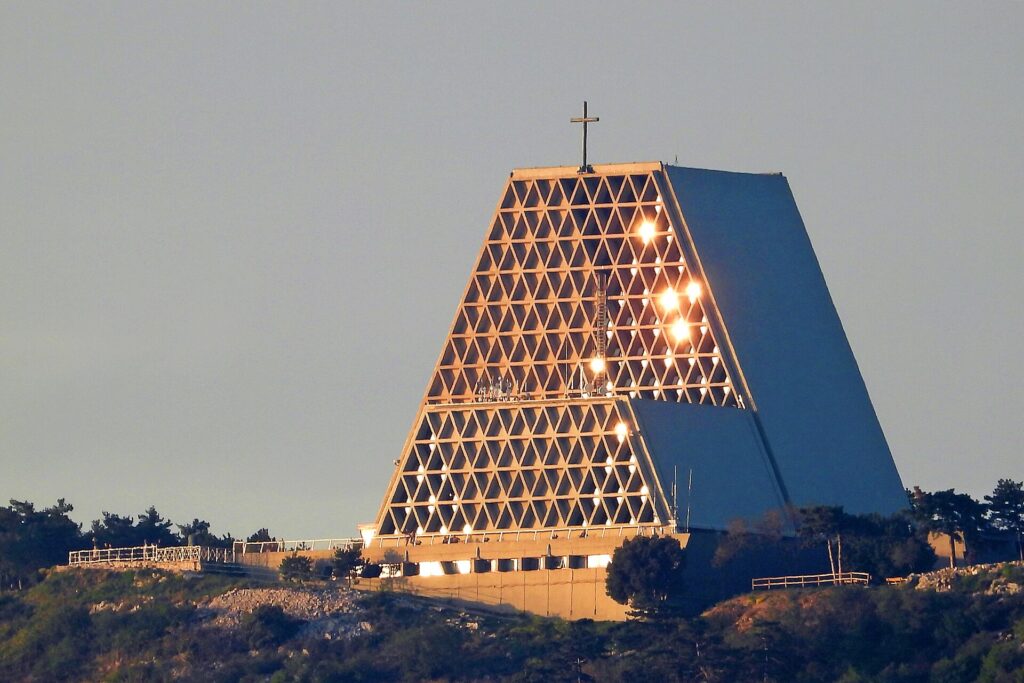
There is nothing delicate about Monte Grisa. It does not try to imitate the neo-classical elegance of the palaces down in the Borgo Teresiano. Instead, it confronts the elements directly. The sanctuary is a monolithic anchor on the edge of the plateau, defining the skyline of the province.
History and Architectural Vision
The story of Monte Grisa begins during the final, brutal weeks of World War II. Bishop Antonio Santin made a vow in 1945. He promised to build a massive church dedicated to the Virgin Mary if Trieste was spared from total annihilation during the turbulent transition of power. The city survived the immediate threat. By 1959, the foundation stone was laid to fulfill that wartime promise. Bishop Santin consecrated the sanctuary on May 22, 1966.
Professor Antonio Guacci designed the sanctuary based on a rough sketch by the bishop. Guacci chose an unapologetic brutalist approach. The building is composed of repeating concrete triangular modules. These interconnected shapes form the letter “M” for Mary. The raw concrete is unyielding and heavy. It feels entirely appropriate for the harsh, rocky landscape of the Karst.
Guacci was not merely pouring concrete. He was translating the theological concept of Mary as a protective mother into a physical form. The intertwining triangles create a highly structured, almost mathematical reverence. In post-war Italy, brutalism was a polarizing choice for sacred spaces. Many traditionalists in Trieste were initially appalled by the stark grey facade. Over the decades, the city has accepted the structure. The concrete has weathered and now blends seamlessly with the natural grey limestone of the surrounding hills.
The brutalist concrete mirrors the exposed limestone of our surrounding landscape. It is architecture without apology, demanding you face the elements.
The Sanctuary Experience: Light and Shadow
The sanctuary is divided into two distinct levels. The Lower Temple is a cavernous, dimly lit space where low ceilings and deep shadows invite quiet introspection, while the air remains consistently cool regardless of the season outside. The walls are thick, and the acoustics muffle the sounds of the wind. It feels like stepping into one of the many natural caves that dot the Karst landscape.
You walk up the wide staircases to reach the Upper Temple. The architectural vision completely shifts here. The walls are essentially vast glass honeycombs set into the concrete frame. Light floods the nave and illuminates the minimalist sacred art. It is a striking study in contrasts. The altar is simple, allowing the geometry of the building to command your attention.
The sanctuary serves a diverse diocese. Masses are frequently held in both Italian and Slovenian. This bilingual liturgy reflects the complex demographic reality of the border region. During the Marian months of May and October, local parishes organize walking pilgrimages up the steep wooded paths from the city. The faithful gather in the Upper Temple, where the high ceilings amplify the choral hymns with remarkable resonance.
The Panoramic View and the Karst Elements
When you stand on teh terrace outside the Upper Temple, the view is staggering. This “Terrazza” is an expansive concrete deck extending toward the cliff edge. It offers arguably the best vantage point in the entire region. The panorama stretches from the working port of Trieste across the water to the Grado lagoon. On clear days, you can easily trace the Istrian coast of Croatia.
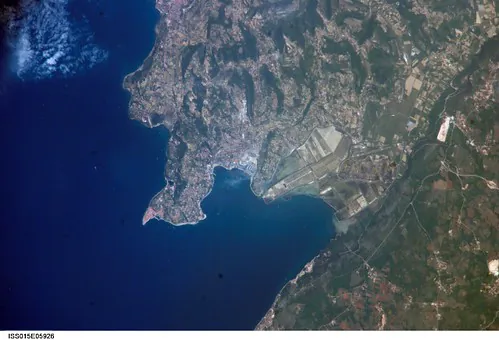
If you lean against the railing, the entire sweep of the coastline reveals itself. Directly below, you can spot the white stone of Miramare Castle jutting out into the water. Further south, the Faro della Vittoria (Victory Lighthouse) stands tall above the neighborhood of Barcola. On days when the sky is completely clear of humidity, the snow-capped peaks of the Julian Alps frame the northern horizon. The geography of the borderlands becomes completely visible. You understand immediately how close Trieste is to the Balkan peninsula.
Monte Grisa is where the raw power of the Bora wind meets absolute silence.
The exposure to the elements is absolute up here. On winter afternoons, our fierce northeasterly wind, the Bora, howls directly through the concrete ribs of the structure. If the forecast predicts strong gusts, you must dress appropriately. The wind chill on the Monte Grisa esplanade can be severe even in early spring. The concrete structure offers some shelter, but the open terrace takes the full force of the gales. I advise wearing a tight-fitting windbreaker and leaving umbrellas in your hotel room. The wind will destroy an umbrella in seconds.
Exploring the Surroundings
Many locals combine a visit here with a walk along the Strada Napoleonica. This wide, relatively flat trail cuts across the limestone ridge and connects the area toward Opicina. The hiking trails around Monte Grisa are rocky and lined with sumac bushes that turn deep red in autumn. Visitors often wonder if Trieste is a walkable city. Down at sea level, the grid streets of the Borgo Teresiano are perfectly flat and easy to navigate on foot. Up here on the Karst, the terrain demands proper footwear.
I always recommend finding a local osmiza after a long walk on the ridge. The osmiza tradition dates back to the Habsburg Monarchy. Emperor Joseph II issued a decree allowing local farmers to sell their surplus wine and homemade produce tax-free for an eight-day period. The word actually derives from the Slovenian word osem (meaning eight). These are temporary farm-to-table taverns marked by a simple branch of ivy tied by the roadside.
You sit at wooden tables with a glass of local Vitovska wine. If you want to know what food Trieste is known for, look past the coastal seafood and try a bowl of jota (a hearty soup of sour turnip, beans, and pork) followed by plates of local prosciutto, pancetta, and aged cheeses. This is the rural soul of the province.
For those looking to expand their itinerary, booking a Panoramic Tour of Trieste and Miramare Castle pairs perfectly with a morning spent on the Karst. Alternatively, a Private Trieste Sightseeing Tour can provide deeper historical context on Bishop Santin’s wartime experiences and the architectural evolution of the city. If you prefer subterranean exploration, the massive cavern of the Grotta Gigante is just a ten-minute drive down the road. You can read more about it in our places to visit guide.
Visitor Logistics
Getting here requires a short journey up from the city center. You can drive up via the Opicina road. There is a large free parking area for cars and tour buses right next to the entrance. If you rely on public transport, Bus Line 42 is the easiest option to get to the sanctuary with. It departs from Piazza Oberdan in the heart of Trieste and winds its way up the steep hillside.
| Category | Details |
|---|---|
| Opening Hours | Daily 07:30 – 20:00 (Subject to seasonal changes) |
| Entry Fee | Free (Donations encouraged for structural maintenance) |
| Dress Code | Modest attire required (shoulders and knees covered) |
| Accessibility | Wheelchair accessible ramps are available |
| Public Transport | Bus 42 from Piazza Oberdan |
Authority Resources
Before planning your trip up the hill, it is wise to verify current liturgical schedules directly through the Official Website or the Diocesi di Trieste. For up-to-date bus schedules, consult Trieste Trasporti. General regional tourism information and trail maps are available via Turismo FVG.
Monte Grisa remains a quiet fixture above the Adriatic. It is a place of silence and vast horizons, far removed from the espresso cups clinking down in the piazzas. You can find more practical travel tips for navigating the region on our practical info page.