
Museo d’Arte Orientale
Trieste and the Far East: An Unexpected Connection
I often find myself sitting at Caffè San Marco on a Tuesday morning, nursing a capo in b—our local espresso cut with milk and served in a small glass—and thinking about the sheer volume of history that passed through this port. Trieste was the primary maritime outlet for the Austro-Hungarian Empire. The ships that departed from our deep-water docks did not just sail the Adriatic. They crossed oceans, navigating the Suez Canal and the Indian Ocean to reach the farthest ports of Asia. You can still feel the weight of those maritime expeditions when you walk into the Museo d’Arte Orientale. It is an unassuming institution near the waterfront, yet it holds one of the most comprehensive Asian art collections in Italy.
The museum is a physical record of a specific era. It is the artifact of a European empire looking outward, driven by trade, diplomacy, and an insatiable curiosity for the East. The merchant families of Trieste funded many of these journeys in the 19th century. Their ships brought back crates of silk, porcelain, and weaponry. These private acquisitions, passed down through generations of local families, eventually formed the core of the civic collection we see today.
Palazzetto Leo: The Architecture of an Archive
The museum occupies Palazzetto Leo, an 18th-century aristocratic residence on Via San Sebastiano. It is a few streets away from the main waterfront and the grand neoclassical facades of Piazza Unità d’Italia. The building itself is beautiful. It has heavy stone arches and uneven wooden floors that squeak underfoot. Walking through its rooms feels less like visiting a formal gallery and more like stepping into the private study of a wealthy 19th-century traveler.
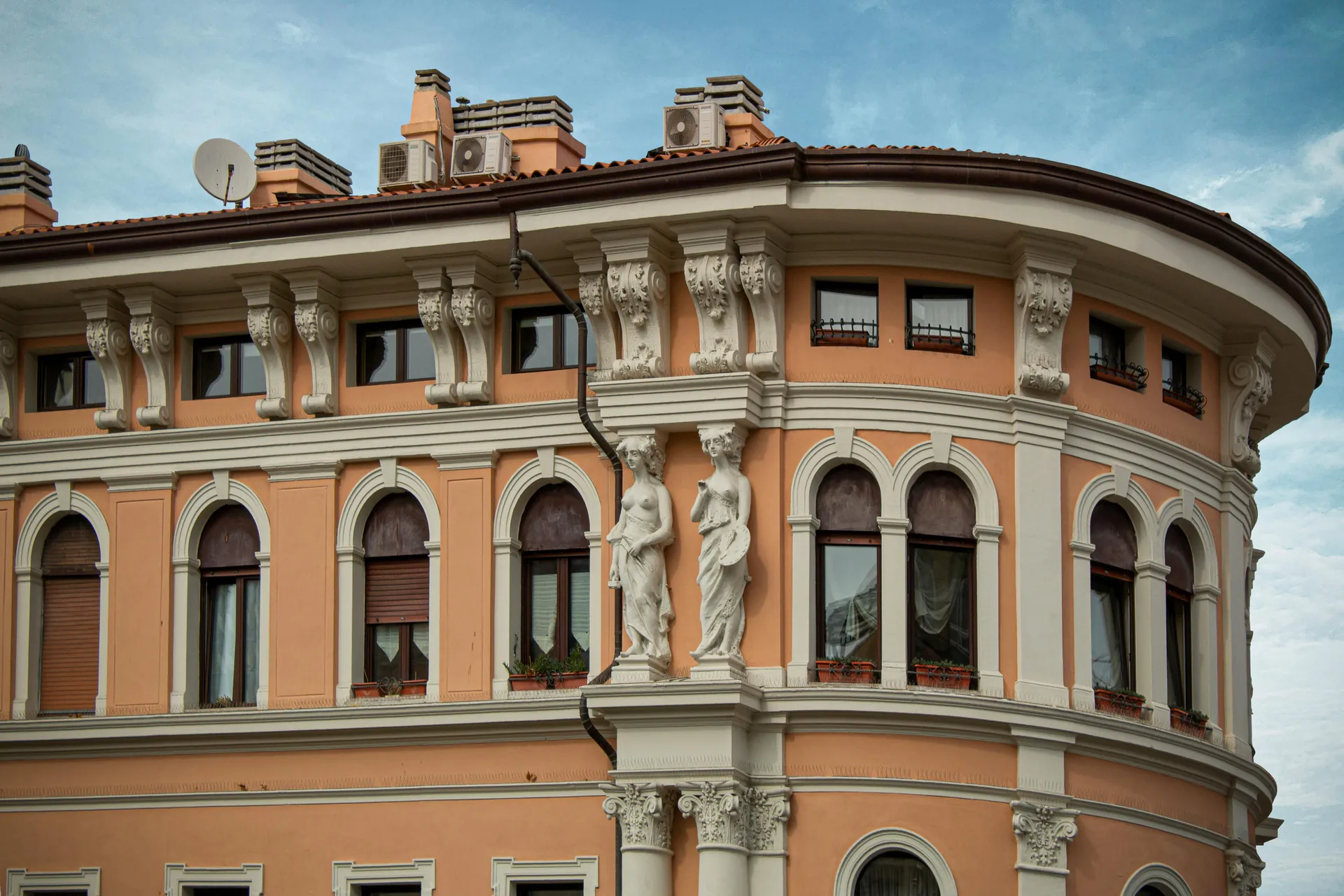
Because the building is a historic home, the rooms are intimate. The architecture dictates the flow of the exhibits. Narrow corridors open up into slightly larger salons. The natural light is kept low to preserve the artifacts, creating a moody, contemplative atmosphere. If you are interested in how this particular building fits into the broader architectural timeline of the city, our Practical Info guide provides more context on the residential history of the old town.
The Collection Highlights
East Asian Treasures
The first floor contains the Chinese collection. It has late Qing dynasty textiles, intricate wood carvings, and export ceramics. The ceramics are thick and heavy. Craftsmen designed them specifically for the rough journey around the Cape of Good Hope or through the Mediterranean. You will see massive blue-and-white porcelain vases alongside delicate silk garments embroidered with traditional motifs. The contrast between the robust trade goods and the fragile personal items is striking.
The Samurai Legacy
The upper floors house the Japanese collection. The armor displays are substantial. It is a quiet space that many visitors walk right past without ever looking at. The Edo-period suits of armor are made of leather, iron, and lacquered silk lacing. They stand in glass cases under dim light, protecting teh fragile materials from degradation. Beside the armor, the museum displays an array of katana swords, tsuba (sword guards), and traditional weaponry that belonged to the high-ranking martial class.
Artistic Mediums and the Floating World
The Ukiyo-e woodblock prints are a major draw for art historians. Ukiyo-e translates to “pictures of the floating world,” a genre that captured the ephemeral beauty of life in Edo-period Japan. The museum owns a vast number of these prints, including works depicting Kabuki actors, sweeping landscapes, and daily city life. Because paper is highly sensitive to light and humidity, the curators rotate these works frequently. You rarely see the exact same prints twice if you visit a few months apart. You can check the Trieste Musei Civici Official Site for the current exhibition calendar.
You will also find a brilliant collection of netsuke. These are miniature sculptures originally used as button-like toggles to suspend pouches from the sash of a pocketless kimono. The craftsmanship is staggering. Carved from ivory, wood, and bone, these tiny figures depict animals, mythical creatures, and ordinary people with intense realism and humor. It is easy to spend an hour just looking at these small objects.
The collection forces you to slow down. The beauty of the Museo d’Arte Orientale lies in its details—the curve of a blade, the stitching on a silk robe, the expression carved into a wooden toggle.
Gandhara and Beyond
While Japan and China dominate the floor space, the museum also holds artifacts from the Gandhara region. The displays here include a small but fascinating collection of Buddhist sculptures from the 1st to the 4th centuries AD. These objects were acquired during the Italian expedition to the Karakorum in 1954, providing a broader understanding of the sheer geographical reach of the civic collections.
Visitor Logistics
Planning your visit is straightforward, though the museum operates on the city’s civic schedule, which can occasionally change around public holidays.
| Detail | Information |
|---|---|
| Opening Hours | Monday, Tuesday, Friday, Saturday, and Sunday: 10:00 AM – 6:00 PM (closes at 5:00 PM in winter). Closed on Wednesdays and Thursdays. |
| Standard Admission | Free admission. |
| Accessibility | Palazzetto Leo is a historic building. Elevators are small, and some thresholds are uneven. Contact the museum in advance for wheelchair access details. |
| Address | Via San Sebastiano, 1, 34121 Trieste, Italy. |
Location and Nearby Exploration
Via San Sebastiano is a narrow, shaded street right in the heart of the old city. The fierce Bora wind rarely reaches down into these tight alleys, making it a pleasant walk even when the gusts are tearing across the main harbor. After you leave the museum, you are in a perfect position to explore the rest of the historic center. The Roman Theatre and the Arco di Riccardo are just a few blocks away.
To understand how these narrow alleys connect to the broader grid of the city, I highly recommend booking a Trieste Walking Tour with a Local Guide. A guide can point out the architectural shifts between the medieval quarter and the grand Habsburg avenues. For more context on the historic center, our Places to Visit page outlines the major squares nearby. You can also check the Trieste Tourism Board for seasonal events in the surrounding piazzas. If you are arriving from out of town, Trenitalia runs regular services to Trieste Centrale, which is a flat, fifteen-minute walk from the museum.
Tips for Your Visit
The museum is rarely crowded. A quick look at TripAdvisor Trieste Reviews confirms that it remains an overlooked archive for most passing tourists. This works to your advantage. You can study the exhibits without being pushed along by large tour groups.
- Timing: Go in the late morning. The natural light filtering through the old windows is best around 11:00 AM.
- Photography: You can take photos, but flash is strictly prohibited to protect the pigments in the textiles and paper prints.
- Pacing: Allow yourself at least an hour. The space is small, but the objects require close attention.
Local tip: If you are hungry afterward, skip the immediate tourist cafes near Piazza Unità. Instead, take a bus up into the Karst plateau to find an osmiza—a temporary farm-to-table tavern where local wine flows freely and the air smells of cured meats and limestone.
A Quiet Refuge in a Port City
The Museo d’Arte Orientale changes your perspective of Trieste. It is easy to view this city solely through the lens of Italian coffee culture or Austrian architecture. The artifacts inside Palazzetto Leo remind us that Trieste was a global node. The sea connected these narrow streets to the Pacific. When you step back out onto Via San Sebastiano, the air smells of salt and roasting coffee, and the city feels just a little bit larger than it did before.