
Getting Around
The Rhythm of Our Streets
I am Elena Valli, and my mornings usually begin with a quick capo in b at Caffè San Marco before I step out into the elements. Trieste is a city heavily dictated by its geography. We have the Adriatic Sea flat against our front door and the steep, rocky incline of the karst plateau rising immediately at our backs. This topography means our transit options are a mix of wide, flat pedestrian boulevards and steep, winding roads that climb up into the surrounding hills. Understanding how to navigate this environment is the key to feeling at home here.
You can trace the grid of the Borgo Teresiano easily on foot. This lower section of the city is a direct legacy of Austro-Hungarian urban planning, making it highly intuitive for visitors. The streets run parallel and perpendicular to the sea. The higher elevations, like the San Giusto hill, require a bit more effort. Locals adapt to these shifts in elevation daily, and you will quickly learn the rhythm of when to walk and when to rely on public transport.
Walking the Historic Center
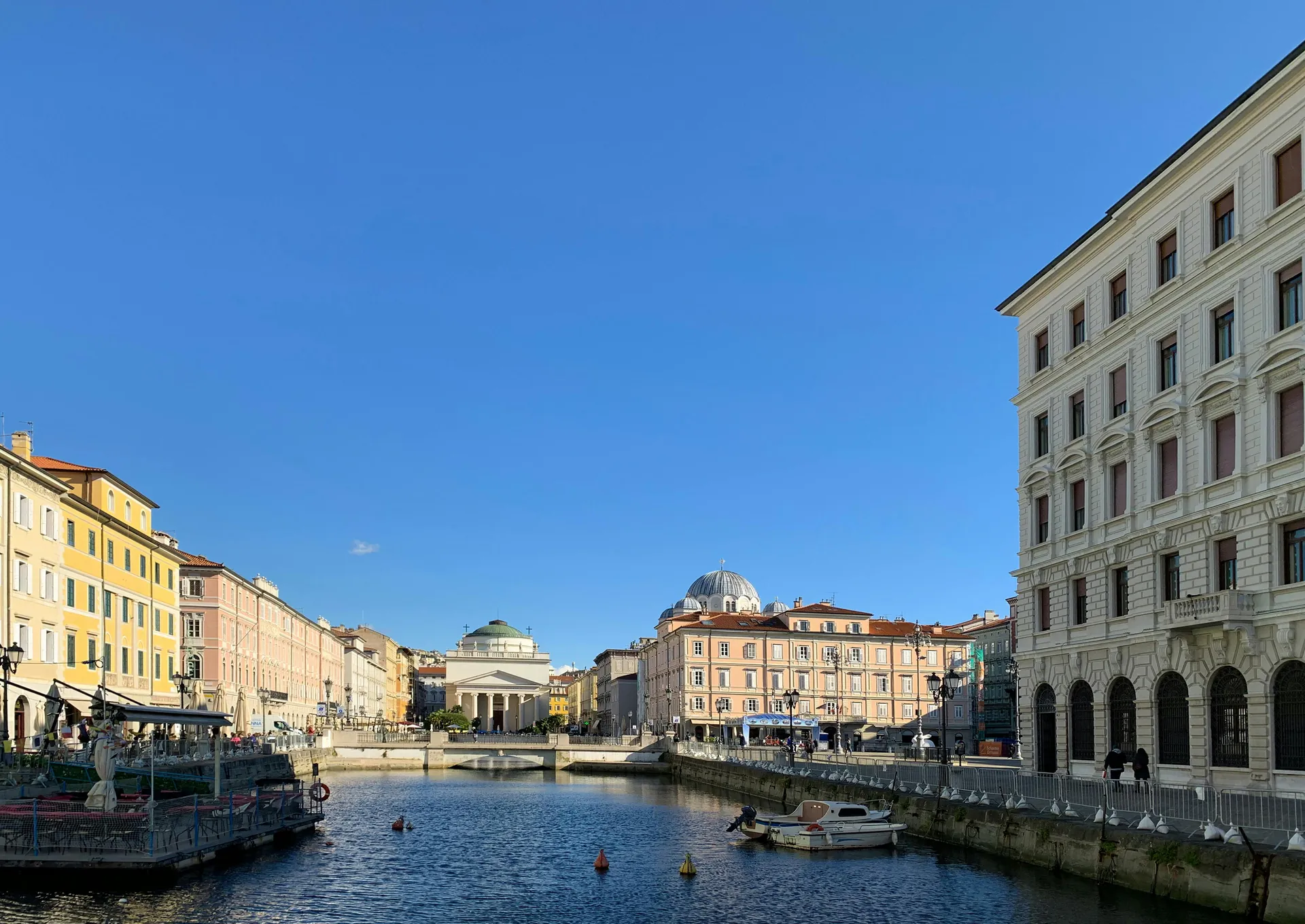
Is Trieste a walkable city? Yes, the historic core is exceptionally pedestrian-friendly. Walking is the absolute best way to experience the immediate downtown area. You can cross the expanse of Piazza Unità d’Italia, wander past the boats docked along the Grand Canal, and explore the narrow alleys of the Cavana district in a single afternoon without ever needing a vehicle. If you prefer a structured introduction to the streets, you can book a Trieste Walking Tour with Audio and Written Guide to absorb the history at your own pace.
When you explore on foot, you will encounter the city’s deep cultural roots organically. At Via S. Spiridione 9, you will find the Tempio Serbo-Ortodosso della Santissima Trinità e di San Spiridione. Its massive domes and Byzantine details are striking against the surrounding neoclassical architecture. A short walk from there, the historic shops offer a tangible connection to our past. Drogheria Toso at Piazza San Giovanni 6 has operated since 1906. The scent of spices and the displays of natural sea sponges remain unchanged. Over on Via S. Nicolò 30, the Libreria Antiquaria Umberto Saba is a dusty, quiet sanctuary filled with rare books, exactly as it was when the famous poet owned it.
Local Tip: You will walk a lot, so stay hydrated. People often ask if you can drink tap water in Trieste. The water from our public fountains is cold, clean, and perfectly safe to drink. Bring a refillable bottle.
Public Transportation: Mastering Trieste Trasporti
When your legs tire, the local bus network is reliable and expansive. The system is operated by Trieste Trasporti under the regional TPL FVG umbrella. The buses run frequently from early morning until around midnight. You cannot buy tickets from the driver. You can tap your contactless bank card directly on the new ‘Eva’ electronic validators, or purchase paper tickets with QR codes at local tabacchi (tobacco shops marked with a large ‘T’) or newsstands before you board. Once on the bus, scan your ticket on the validator.
The most efficient method is to download the TPL FVG mobile app. It allows you to purchase digital tickets and track real-time bus arrivals. If you want to reach teh upper hills or the suburban neighborhoods, checking the app is essential. January is the coldest month in Trieste, and waiting blindly at a bus stop when the fierce Bora wind is blowing at 100 kilometers per hour is a miserable experience. The app prevents unnecessary exposure to the elements and tells you exactly which stop to get off at.
For official route maps and service changes, you can refer directly to the Trieste Trasporti website.
Reaching Key Destinations Outside the Center
While the center is compact, some of our most famous sites require a short transit ride. Here is how you access the main attractions on the city fringes.
Miramare Castle
Located at Viale Miramare, this white stone castle sits on a rocky promontory over the sea. You can reach it easily by taking Bus 6 from the city center. During the summer months, Bus 36 also runs along the coast to the castle gates. The ride takes about 20 minutes from the central station. If you want to read more about the castle’s history, check our Places to Visit guide.

Riserva Naturale della Val Rosandra
The Val Rosandra is a rugged nature reserve near the Slovenian border. Take regional Bus 40 or 41 from the main bus station. Get off near San Dorligo della Valle to access the hiking trails leading to the Vedetta di San Lorenzo. If you visit in the summer, be aware that there are mosquitoes in the lower, wetter parts of the valley, so pack repellent.
Accessing Underground History
Trieste has a vast network of subterranean spaces. Visiting these sites requires a bit of logistical planning. Kleine Berlin is a complex of underground air-raid shelters built during World War II, located at Via Fabio Severo. It is an easy uphill walk from the train station, but access is restricted to scheduled guided tours. You must check their operating hours before walking up the hill.
The Speleovivarium Erwin Pichl is located at Via Guido Reni 2/C. This museum is housed in another former air-raid shelter and focuses on the unique cave-dwelling amphibians of the karst region, like the olm. You can take Bus 8 or 9 from the center to get close, followed by a short walk into the residential district.
The Opicina Tram: A Historic Anomaly
The Opicina Tramway is an unusual piece of transit engineering. It operates as a standard streetcar in the city center and converts into a cable-pulled funicular to climb the steep grade up to the village of Villa Opicina. It is a famous symbol of Trieste. The tram is currently undergoing a prolonged period of maintenance and structural testing. Service is frequently suspended and replaced by Bus 2. You must verify its operational status locally before planning your day around it.
Day Trips and Cross-Border Transit
Because of our geographic location, crossing international borders is a normal part of life here. Can you visit Slovenia from Trieste? Absolutely. The border is only a few kilometers away. You can catch regional buses from the main station right into Slovenian coastal towns. If you want a more guided experience across the border, you can reserve a Piran & Panoramic Slovenian Coast from Trieste excursion.
For those arriving by cruise ship or needing to connect to major hubs, navigating to Venice is a common requirement. Regional trains run frequently between Trieste Centrale and Venezia Santa Lucia. If you have significant luggage, a Private Transfer from Trieste Port to Venice is often the most practical choice.
Taxis and Ride-Hailing
Taxis are available, but you cannot flag them down on the street. You must go to a designated taxi rank or call the local dispatch. The primary ranks are located outside the central train station, in Piazza della Borsa, and Piazza Goldoni. Ride-hailing apps like Uber have very limited functionality here, operating only with licensed black car services (Uber Black), which are more expensive than standard municipal taxis.
If you need reliable transport to catch a flight, you can book a Small-Group Transfer from Trieste City to Trieste Airport in advance. Trieste Airport (Ronchi dei Legionari) is about 40 minutes away by car. Alternatively, regional trains connect the central station directly to the airport terminal.
Cycling and Parking Logistics
Trieste is making progress with micro-mobility. You will find public bike-sharing stations clustered along the waterfront (the Rive) and near the train station. Riding a bike along the coast toward Barcola is pleasant, but cycling up into the karst hills requires serious stamina or an e-bike.
If you arrive by rental car, parking requires strategy. The historic center has several Restricted Traffic Zones (ZTL) where unauthorized vehicles are heavily fined. The easiest solution is to use large underground facilities. Park San Giusto is carved directly into the hill behind the Roman theater. The parking garages are designed to accomodate standard vehicles, though larger SUVs may find the spiraling ramps tight. You can check parking regulations on the Comune di Trieste official portal. For more details on renting a vehicle or understanding local tolls, visit our Practical Info page.
Search Transport Options
Use the search tool below to find available cars, transfers, and transport options for your dates in Trieste.
Current Conditions and City Map
Before you set out for the day, check the local weather. The wind here changes rapidly, and a calm morning can turn into a blustery afternoon.